- Home
- Property Types We Roof
- Government Building Roofing
Government Building Roofing in Santa Clara, CA
Wet-period procurement planning needs a clear examination boundary. The Bay Area atmospheric rivers spanning late December 2022 and mid-January 2023 give government facility managers in Santa Clara, CA a practical question: which roof findings support priced construction, and which still need investigation? We inspect the accessible assembly and describe the work supported by the findings. Historical Bay Area rain supplies a planning reason to resolve those questions early. It does not establish damage or a replacement requirement at a public building.
A public roof decision may involve maintenance staff, purchasing and another approval authority. We identify the responsible contacts for the subject project. The report separates known repairs, conditional quantities and work requiring a design or trade decision. A bid sheet can then move through the applicable process with usable information. The manager should not have to translate a vague instruction to reseal everything into an identifiable construction scope.
Government Building Roofing: What the Work Covers
A repair quantity needs a location and a defined boundary. We describe which detail is affected, how it will be prepared and what compatible materials are proposed. The scope also distinguishes removal, rebuilding and final protection. If the task depends on a concealed condition, that dependency is stated. The purchasing reviewer can then see which item is firm and which requires investigation or a conditional allowance.
Written roof condition reporting puts those quantities beside photographs and examination limits. A finding that could not be reached is not counted as a confirmed defect. Where further access or sampling is needed, we specify the next task. That creates a reviewable procurement item instead of forcing uncertainty into a fixed construction total. The responsible agency determines its own purchasing route and approval rules.
A public entrance can be unsuitable for material deliveries even if it is convenient to the roof area. We agree on unloading, storage and construction routes with the responsible facility contact. Visitor circulation and required emergency paths need separation from the work. Any temporary access change receives authorization before the route is restricted. The bid states the handling requirements because they can affect labor and the daily sequence.
The office/R&D development along Scott Boulevard makes operating limits a useful local planning subject. For a public facility project along Scott Boulevard and Tasman Drive, we obtain the subject building instructions and inspect its own roof. The responsible contact identifies visitor hours, deliveries and sensitive services. Those requirements inform the sequence without determining the membrane or implying a condition from nearby construction.
A loose wall termination and a damaged field seam require different corrections. We inspect accessible construction and identify the affected connection. The repair must restore that detail with suitable support and compatible materials. Surface sealant can obscure a defect without rebuilding the connection beneath it. The report explains the proposed work and any investigation needed to establish its full extent.
Commercial roof repair work should also identify unsound material beneath the visible opening where findings support removal. A small exterior defect may have a larger concealed footprint. We show how additional work will be measured and approved if discovered. That distinction lets the manager explain a changed quantity to the approval authority and retain the evidence with the project file. The change should not be accepted as an unbounded instruction to keep removing material.
Planning and Completing the Work
A project involving school roof construction can have calendar limits distinct from work at office buildings. A government facility also needs its own operating instructions. We confirm which rooms and services are affected by noise, odors or temporary exposure. The roofing plan identifies these construction effects. Facility staff authorize changes to public services and building use through their responsible process.
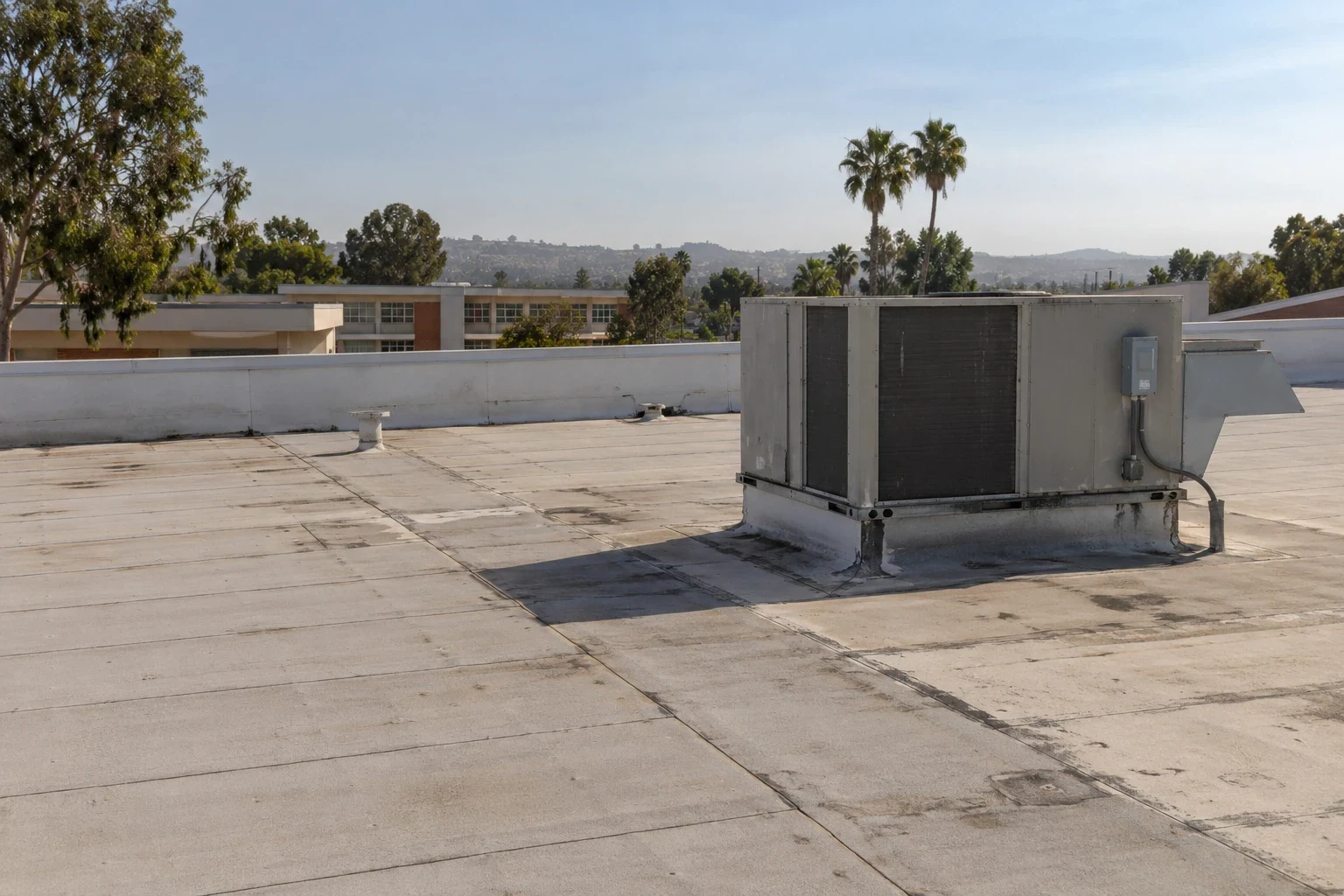
Work near rooftop equipment may require another trade. The operator identifies who can authorize equipment isolation and which service routes must remain available. We define the roofing interface, not an assumed shutdown schedule. If a curb or support alteration needs design review, the bid marks that decision as pending. The manager can then resolve the dependency before purchasing a roof task that cannot proceed under the current operating restrictions.
An outlet blocked by accessible loose debris may need cleaning. A damaged membrane connection needs roofing repair. A plumbing defect or drainage design concern may require another professional. We identify those distinctions during the examination and show them in the proposed scope. One line called drain service can hide several unlike tasks. The reviewer should know which work is included and which coordination remains necessary.
For drain and scupper corrections, we record the location, accessible condition and proposed connection detail. We also identify examination limits at secondary outlets. Persistent water at a low point needs assessment before a surface treatment is recommended. A coating is not a substitute for correcting unsuitable support or drainage. The manager receives a defined next step rather than an assumption that any remaining water proves a membrane failure.
Active leakage needs facility protection and a roofing assessment in parallel. Responsible staff control visitor routes, electrical precautions and any room restrictions. We need the affected location and approved access to evaluate the roof action. For an urgent leak, we assess approved access and workable conditions before recommending immediate protection. Safe access and workable conditions govern the intervention, so the immediate recommendation distinguishes what can be protected now from what requires a suitable period.
We document temporary measures with their location and purpose. The follow-on scope identifies the permanent detail and preparation needed for the actual assembly. Purchasing or other approval requirements still need to be addressed through the agency process. The manager can use the emergency record to explain the condition and the remaining task without treating a temporary patch as completion of a larger capital project.
A replacement alternate changes removal, insulation and detail construction together. We state those changes beside a repair option, including the basis for retaining any existing layers. Suspected moisture is investigated before a recover recommendation is settled. Conditional deck correction and access restrictions are shown separately. The proposal should give the reviewer the construction assumptions needed to compare totals on a consistent basis.
A pre-season roof inspection can establish those questions before the procurement decision. At closeout, accepted changes, installed material identification and location photos remain with the roof file. Actual warranty terms are retained alongside them. The manager finishes with a complete scope and evidence of the work performed, while the agency keeps control of purchasing, operational decisions and any further capital approval.
Public building approvals: document procurement and access steps. A public-building roof proposal should identify the contracting authority, procurement requirements, site-access rules and any review steps supplied by the owner. The roofing team can describe its scope and construction sequence; the agency retains responsibility for procurement approval, facility operations and any required design review. State which conditions are included, which are allowances and what documentation supports a change if concealed damage appears. Where public access continues nearby, show the planned work boundary and protective measures for review by the agency. Closeout should include acceptance evidence and open items in the format requested by the contracting authority.
Public facility check: prepare a measurable bid
Schedule a pre-season assessment. We will provide a plain bid sheet with repair quantities, examination limits and public-access coordination.
Frequently Asked Questions
State the access limits and next investigation tasks. Unreached areas should not be counted as confirmed repair quantities.
The responsible agency controls procurement. We provide the defined roof scope and supporting findings.
The bid must identify the included task. Roofing connections, cleaning and plumbing corrections are separate responsibilities.
A temporary measure has limited purpose. The permanent construction still needs its defined scope and acceptance.
Keep removal, support, flashing, drainage and access assumptions visible beside each assembly.
Roof Assessments
Santa Clara & the South Bay
Membrane, flashing, drainage and edge details checked and written up before any work is priced.
Request a Roof Assessment